 THE UNIVERSITY OF CHICAGO
Why we think Emergence is the Future of Science
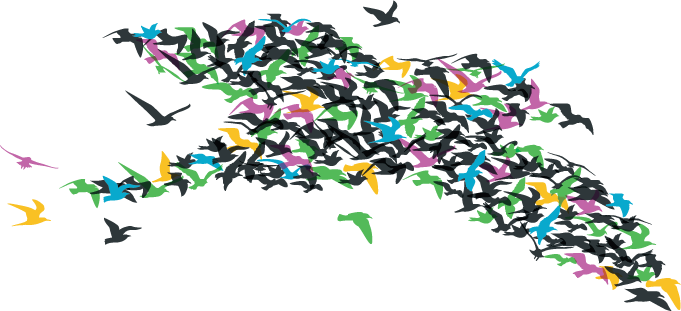
Science has spent centuries breaking the world into parts. Physics gave us atoms, biology gave us genes, chemistry gave us reactions. Reductionism has been great, useful, and applicable. But it is reaching its limits.
Increasingly, the biggest questions we face are not about the parts, but about what happens when the parts come together. How do bacterial strains coordinate to clear an infection? How do tumor cells self-organize into microenvironments that suppress the immune system? How do ecosystems maintain balance despite environmental disruption? These aren’t just ‘complicated’ systems, they are emergent. Functions of these systems come about at higher levels that cannot be predicted simply by cataloguing the pieces.
- In the Raman Lab, we believe the future of science is learning to read, and eventually design, emergence. What does this practically mean?
- What are the constraints? Every emergent system is shaped by rules it must obey.
- How do these rules scale? Emergence often comes from constraints stacked across scales. What holds true for a molecule, a cell, a tissue, and an ecosystem simultaneously.
- Can emergence be engineered? If we understand these constraints, we may be able to design microbiomes that restore health, or synthetic ecosystems that produce new materials.
- Is there a unified theory of emergence? Is there a mathematical formalism that we can derive and understand that describes emergent phenomena?
Science has primarily been a discipline of dissection (with a a few noteworthy exceptions). We pose that the next era will be one of design and composition, with the central piece of the board being emergence. While historically emergence has been feared, we feel this is no longer true. It’s simply a map we haven’t learned to read in a human-interpretable manner yet. As our lab continues its work, we hope that we won’t just understand Nature better; we’ll learn to build with it.