 THE UNIVERSITY OF CHICAGO
Physics of Natural Systems
What would a physics of living systems look like?
Unlike atoms or planets, living systems are not easily describable by universal laws. They are products of ancestry—sculpted by evolution, constrained by history, and embedded in environments that shift over time. As a result, there is no existing statistical physical formalism that explains how biological systems organize themselves across scales. The rules that govern life are not written in invariant equations, but in patterns of constraint and variation passed down through lineage and filtered by selection.

We are building a framework to make these rules visible.
Our goal is to develop a statistical physics of evolved systems—one that reveals how constraint gives rise to complexity and how the space of possible forms is shaped by what came before.
We approach this problem by treating biological diversity as a source of deep structure. Genomes, microbial communities, and tissue states may appear messy or idiosyncratic, but when viewed correctly, they reveal latent organization. By developing new tools of applied mathematics based, we extract the axes of variation that define feasible biological states. These axes do more than describe similarity—they uncover the statistical constraints that evolution has carved into high-dimensional space.
Underlying our approach is a core thesis: evolution leaves behind structure. That is, selection acts not just on outcomes, but on the geometry of variation itself. Feasible systems cluster in latent space, infeasible ones fall away. In this view, evolution is as sculptor and the distribution of forms we observe is a reflection of its signature. By learning and inferring that signature statistically, we can build models that are explanatory, predictive, and generative.
Our long-term vision is to create a new physics—one tailored to life’s constraints and shaped by life’s history. This physics will not rely on mechanistic completeness, but on the legibility of emergent structure. By uncovering the statistical rules that govern biological organization, we aim to transform how we understand diversity, how we predict the effects of functional systems, and how we can build new ones.
References
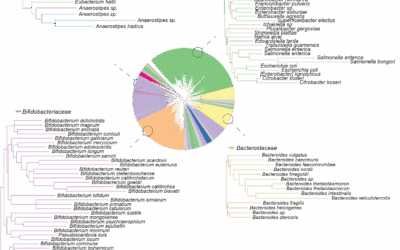
Subspecies phylogeny in the human gut revealed by co-evolutionary constraints across the bacterial kingdom
With the advent of sequencing, biological systems like bacteria can be described in a myriad of ways, including by their entire genome sequence. But, with this capacity comes a conundrum. Do we actually use the whole genome to describe a bacterial strain? Should we...
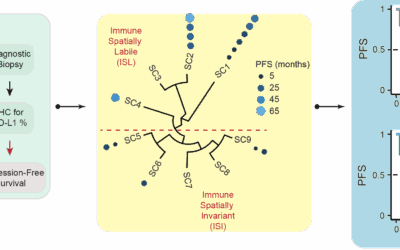
Conserved principles of spatial biology define tumor heterogeneity and response to immunotherapy
Emergent phenomena are everywhere in biology—from macro-ecosystems like birds flocking and ants foraging down to the scale of ecosystems of amino acids that comprise a protein. One important ecosystem that holds immense clinical relevance is the ‘tumor...
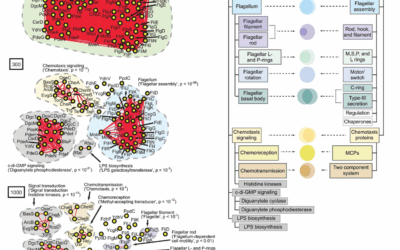
Defining hierarchical protein interaction networks from spectral analysis of bacterial proteomes
If one were to buy a furniture set and accidentally lose the instruction manual, could we put the furniture back together? This is the question facing biologists all the time. We inherit systems from nature that are built according to a process that is opaque to us...
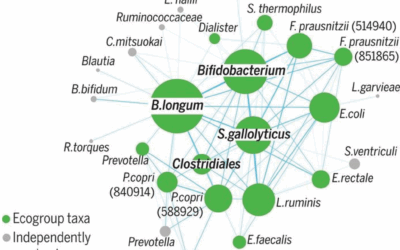
A sparse covarying unit that describes healthy and impaired human gut microbiota development
The human gut microbiome is comprised of many species that all interact in strange ways so that we can be healthy and veer off disease. Given its importance, what is a good way to describe the microbiome? Before this paper, the idea was to describe by a list of...
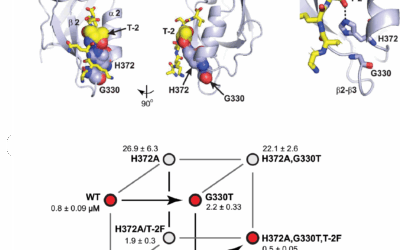
Origins of Allostery and Evolvability in Proteins: A Case Study
Nature creates wonderfully complex micromachines known as proteins. While much effort has gone into understanding how these machines fold into compact structures and execute their function, little is known about the principles underlying their capacity to adapt to new...