 THE UNIVERSITY OF CHICAGO
Evolution and Emergence
The ‘Why’ of Emergence
While engineering and inference can reveal how complex systems function and how they can be built, a deeper question remains: Why did they arise this way in the first place? What determines the architecture of a microbial community, the structure of a genome, or the layered organization of a tissue? Our lab seeks to understand emergence not only as a pattern, but as a consequence of long-term environmental and evolutionary forces. This set of research seeks to answer what selects for emergence?
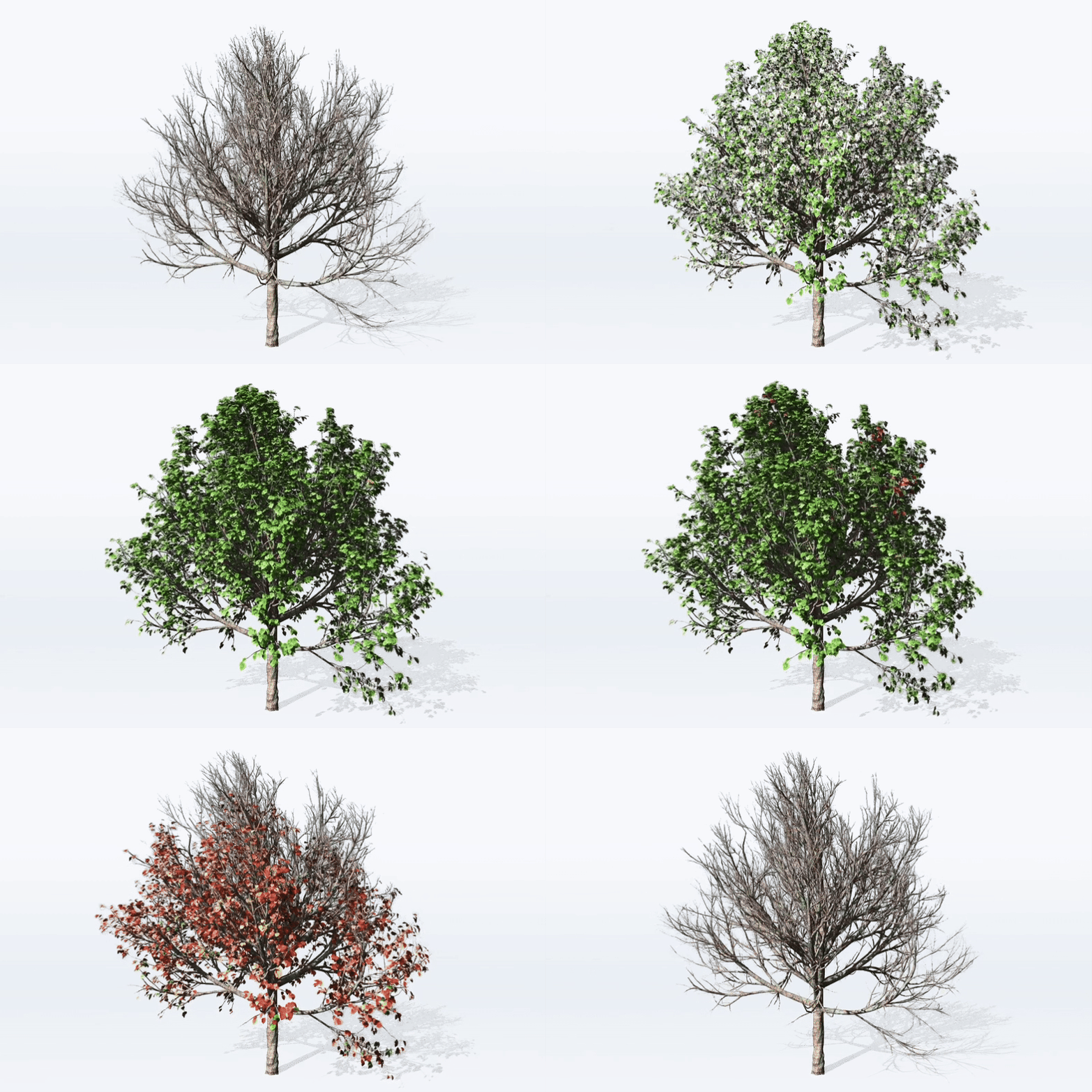
Biological systems are not designed in the engineering sense—they are the result of iteration, filtered by selection and shaped by corresponding pressures felt on generational timescales. Over evolutionary time, living systems adapt not just to specific tasks, but to the statistical structure of their environment. Or at least, this is what we hypothesize. The result is not necessarily optimality, but feasibility—systems that are shaped by what has worked across a wide range of conditions and has maintained the capacity to adapt to new conditions rather than what is perfect in any one condition.
This view has profound implications. It means that the architectures we observe—metabolic networks, regulatory hierarchies, ecological communities—are not arbitrary. They are records of constraint, shaped by historical pressures, ecological dynamics, and the need to remain adaptable under changing conditions. Just as rivers carve out channels that reflect both flow and resistance, evolution carves out solution spaces that reflect both function and constraint.
We believe that evolution leaves behind structure in the form of extant diversity that can be read. And the way we test this idea is through long-term evolution experiments. Through carefully changing environmental structure and measuring system structure, our goal is to evaluate whether the origins of emergence come from the statistical structure encoded in environmental dynamics.