THE UNIVERSITY OF CHICAGO
Conserved principles of spatial biology define tumor heterogeneity and response to immunotherapy
Emergent phenomena are everywhere in biology—from macro-ecosystems like birds flocking and ants foraging down to the scale of ecosystems of amino acids that comprise a protein.
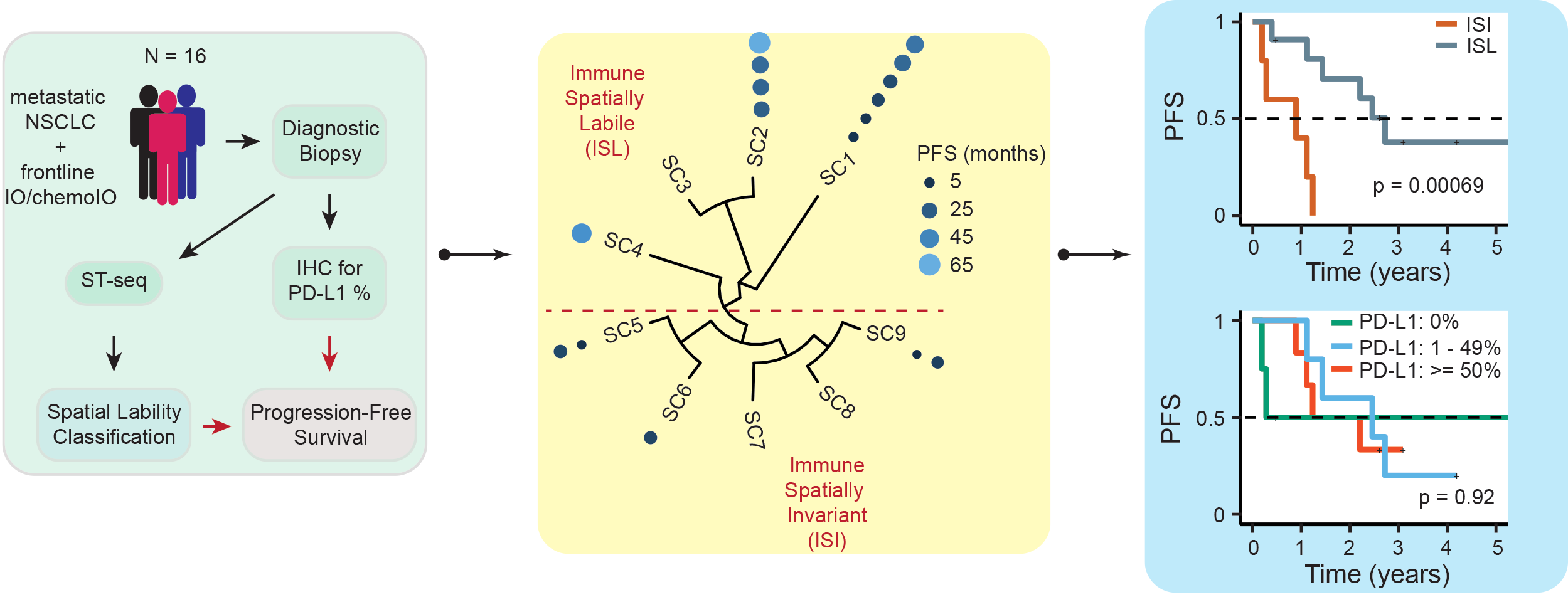
One important ecosystem that holds immense clinical relevance is the ‘tumor microenvironment’ (TME)—the cellular ecosystem surrounding a tumor. At first glance, the complexity of this system is immense: there are hundreds to thousands of cells with each cell harboring its own degrees of freedom and interacting with other cells in unintuitive manners. However, when could this complexity be simplified if this system were conceptualized as an emergent whole? Here, we extend our study of emergence to the TME and show, through statistical analysis of many TMEs collected from patients, that there is a statistical organization of transcriptional covariation that maps to a hierarchical structural interaction network comprised of groups of cells we term ‘Spatial Groups’. We demonstrate the biological importance of Spatial Groups and find
that parametrizing TMEs by their Spatial Group content directly enables predicting responders and non-responders to immunotherapy in the setting of non-small cell lung cancer. To our knowledge, this is the first instance of using spatial transcriptional profiling to make a direct clinical prediction—a result enabled by our fundamental study of the statistical physics of emergence.
Click the preview above to download the paper in full.