 THE UNIVERSITY OF CHICAGO
Synthetic Biology and the Design of Emergent Systems
If we can uncover the rules of emergent systems, can we use them to build new ones?
One of our laboratory’s core philosophies is that emergence—the phenomenon of parts naturally coming together to create collective wholes—is not magic, it is structure. If structure can be learned, it can also be engineered and steered. While much of biology is still approached from a reductionist lens—isolating parts to understand collectives—we focus on learning the statistical constraints that give rise to emergent function. We then use those constraints as a blueprint for engineering.

Synthetic biology offers a unique proving ground for this idea.
Living systems are naturally modular, adaptive, and robust—features that emerge not from individual components but from the constraints that govern how components interact. By inferring these constraints directly from data, we can design systems that are robust by construction.
One of our key platforms is the statistical design of microbial consortia. In our work, we have assembled a 15-member synthetic microbiome (‘SynCom15’) capable of suppressing multidrug-resistant Klebsiella pneumoniae. The design did not rely on metabolic models or ecological heuristics. Instead, we a constraint distillation process to identify low-dimensional axes of community structure most predictive of suppression.
Indeed, the generalization of parts creating collectives goes well beyond microbiome design. Conceptualizing neurons in a neural network as a parts-list, we have created a new AI framework called the ‘Emergent Structure Neural Network’ (ESNN) that was the result of architectural distillation of how natural systems evolve. Where traditional deep-learning captures correlations, the ESNN learns constraints. It builds latent spaces where structure is primary, generalization is emergent, and inference is interpretable. The ESNN is thus both a tool and a case study: a synthetic system built from the principles of emergence itself.
In all of this, we treat design not as trial-and-error, but as inference. By distilling what evolution has already solved, we constrain the space of possibilities. We don’t predict function from mechanism—we predict function from structure. Then we use that structure to build.
References
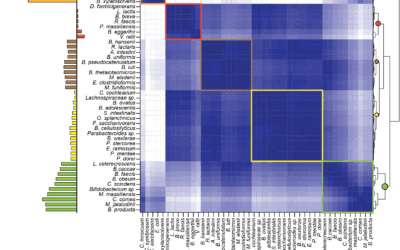
Statistical design of a synthetic microbiome that clears a multi-drug resistant gut pathogen
Given a set of parts and no pre-determined instruction manual on how to put these parts together, how can we create a system that works? The concept of microbiome design is not new, but ways of approaching the problem have focused on just two paths: ‘bottom-up’ and...